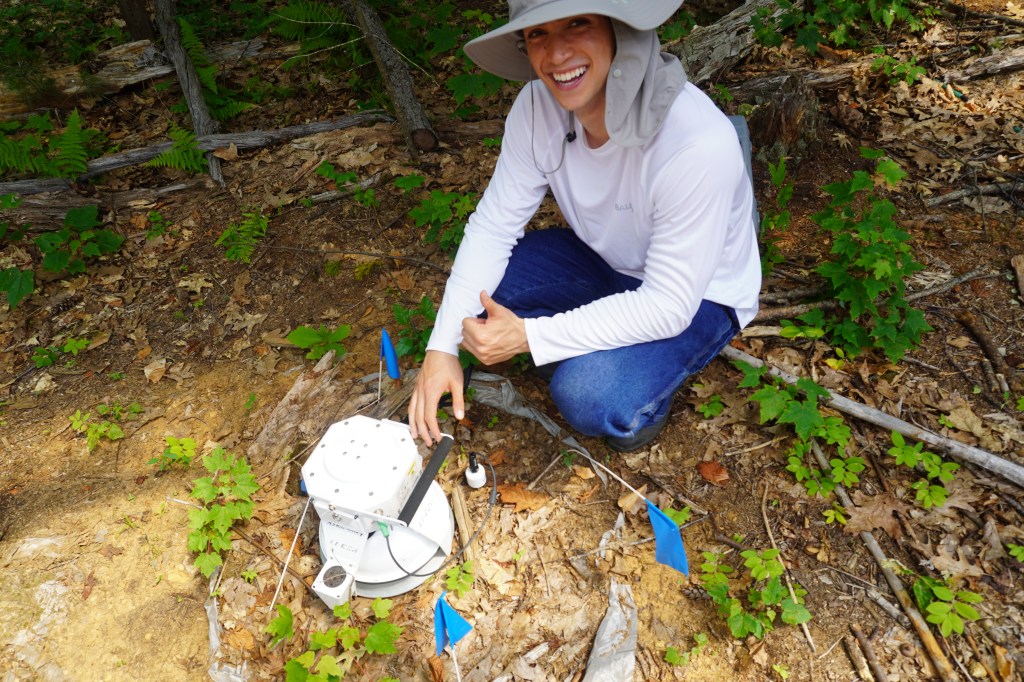
This summer, I spent around 11 weeks at the Harvard Forest Summer Research Program in ecology. I had loads of fun spending time making new friends, spending time outdoors, and gaining a better idea of what I want my career to look like as an aspiring ecologist. I am so grateful for this experience, and it has been nothing short of transformative. This summer, I joined ecologist Dr. Andrew Reinmann and his project at the Harvard Forest CliFF (Climate Interactions in Forest Fragmentation) site, studying the impacts of forest fragmentation and water availability on ecosystem carbon fluxes and tree ecophysiology in temperate forests. This experience highlighted the critical role of below-ground ecosystem processes, revealing that far more is happening than what we see above the surface.
Within this larger project, I studied the impacts of forest fragmentation and climate on soil fluxes of CO₂ and CH₄. What initially drew me to this project was its broad application for a wide range of ecosystems and scenarios. In our changing world, forest fragmentation is becoming much more common, and as of 2015, 70 percent of our world’s forest exists within 1 kilometer of a forest edge. With changes to our earth’s climate, I thought it would be beneficial to understand how the largest driver of ecosystem carbon flux is impacted by these two anthropogenic drivers, which will then help account for a more detailed understanding of ecosystem net primary productivity (NPP). As a researcher from Hawaiʻi, I was motivated to pursue work that could be applied to island ecosystems. Examining the effects of temperature and moisture on soil respiration provides a framework for understanding processes back home.
To start, I learned that forest soil fluxes of CO₂ and CH₄ are largely driven by two metabolic processes: 1. autotrophic respiration (which is the process of plants breaking down sugars from photosynthesis to fuel their growth, releasing carbon as a byproduct) and 2. heterotrophic respiration (which is respiration performed by organisms that break down organic matter). The two largest variables impacting soil respiration are temperature and moisture (volumetric water content). Soil CO₂ respiration levels tend to peak at around 25 degrees Celsius, while too much or too little moisture can both negatively affect respiration levels. Soil respiration dynamics then become more complex when forest fragmentation is considered. At a forest edge, temperate forests often experience around a 15-26 percent increase in growth due to the altered microclimates from more sunlight, higher temperatures, and wind availability. From a carbon sequestration standpoint, we also end up seeing greater carbon uptake at an edge than in the interior within temperate forests.
With this information in mind, I developed two different questions for my research at Harvard Forest.
How does soil respiration vary across an edge-to-interior gradient?
- With forest fragmentation becoming increasingly prevalent, I was curious about how soil respiration levels would be affected. This way, we could develop an improved understanding of carbon dynamics in our changing world.
What are the roles of temperature and moisture in influencing the response of soil respiration?
- With climate projections in the New England region projected to increase by 5.8 to 6.8 degrees Celsius by 2080, and precipitation patterns expected to increase by 3 – 5 percent per Celsius increase of local warming in the Northeast United States, I sought to understand how soil respiration would be affected under future climate scenarios.
After developing my research question, I spent a total of 5 weeks measuring soil respiration across an edge-to-interior gradient at the Harvard Forest CliFF site within three different climate scenarios. There were 6 plots at the Harvard Forest CliFF site, with the first two representing total throughfall removal through installing plastic around trees to direct the water to a basin in the middle of the clearing, two representing our reference scenarios, and the last two representing our throughfall addition plots, where we hoped to pump water we collected from the first two plots to this area. However, for the sake of this experiment, I focused on comparing the throughfall removal plots and the reference plots, as we didn’t have enough rain this summer to significantly increase precipitation. Collars were measured at around 10 m increments up to 30 m into the forest. Regarding instruments, I used the LI-7810 and 8100-01S Smart Chamber (LI-COR Biosciences) series.
In comparing the control and drought plots, I found that drought seems to suppress the edge effect on respiration, and as we move from the edge to the interior of the forest, we see a gradual increase in soil respiration. This is typical in new forest edges, as new forests are often more impacted by the microclimatic conditions at an edge due to less lateral growth and leaf fall attributed to maturity, which all contribute to less soil respiration than older forests. I then looked at the drought plots’ effect on soil respiration and noticed that the CO₂ flux measurements were around the same across the forest spatial gradient! Drought plots do not have the same relationship to distance as the control plot does, suggesting that moisture is a limiting factor.
Additionally, temperature tended to increase slightly with CO₂ flux in the control plot, which I expected. Then when looking at the drought plots, I saw that there tended to be similar levels of respiration in the drought plot, even with the increased temperature! This pointed to moisture as a limiting factor. Then when I looked at the volumetric water content of the drought and control plots, I saw two contrasting results across both plots. Within the control plot, I saw as VMC increased to around 30 percent that it correlated with an increased level in respiration. When we looked at the VMC levels within the drought plot and their corresponding respiration levels, we saw significantly lower VMC and respiration levels, further pointing to VMC also limiting the inducement of temperature on soil respiration!
This project taught me that moisture seems to be a more influential factor in soil respiration, with temperature being the secondary driver.
As a new researcher, this experience taught me that the process of coming to a conclusion to your answers within science isn’t always so straightforward! For example, initially, it didn’t cross my mind that the age of a forest could have a significant effect on soil respiration levels. I thought that the age of a forest wouldn’t be an influential factor on respiration, as I thought that all forests would follow a trend of respiration increasing at an edge, then decreasing as they moved towards the interior. However, I found that mature forests tend to have increased respiration levels at the edge, which would then taper gradually as one moves to the first interior. I found that newer forests exhibit this reverse relationship, with newer forests having suppressed respiration at the edge in comparison to the interior. This tends to be due to part of the maturity of the forest affecting processes such as leaf litter fall and the amount of lateral growth present at the edge. These mature conditions tend to dampen the negative effects of the extreme microclimate by blocking out extra heat while still having increased levels in soil respiration. With this research providing me a basic understanding of carbon cycling in relation to climatic and fragmentation influences, I hope to apply this information back home to my state of Hawaiʻi, where one day, I hope to become a climate ecologist focused on preserving Hawaiʻi’s ecosystems. Hawai’i has already lost half of its endemic forest cover since the onset of human arrival, and with more and more individuals moving to Hawai’i and our population expanding, more and more forests are expected to be fragmented, therefore risking altering our forests from carbon sources to sinks. Our forests are also younger due to the fact of being an island; our geological formations are much younger than forests on the continent, allowing these ecosystems to have a longer period of colonization. The need for proper land management strategies has become ever so important. Especially in the wake of the devastating forest fires of Lahaina in 2023, it was uncovered that a combination of forest fragmentation, invasive species, and the mismanagement of our state’s water resources created the perfect condition for this devastating event to occur. I hope that proper understanding of carbon cycling in Hawaiʻi’s ecosystems could help incentivize their protection to further prevent the frequency of natural disasters from occurring.
I want to say thank you to everyone at Harvard Forest for encouraging me this summer, to Chefs Tim and Peter for feeding me, and to my mentors Andy, Joe, Junior, JP, and Grady, who always answered any questions I had about my project. I also want to say how indebted I am to everyone in this program for increasing my passion for ecology, which I will carry with me for the rest of my life.
 Timothy Wiley
Leave a comment