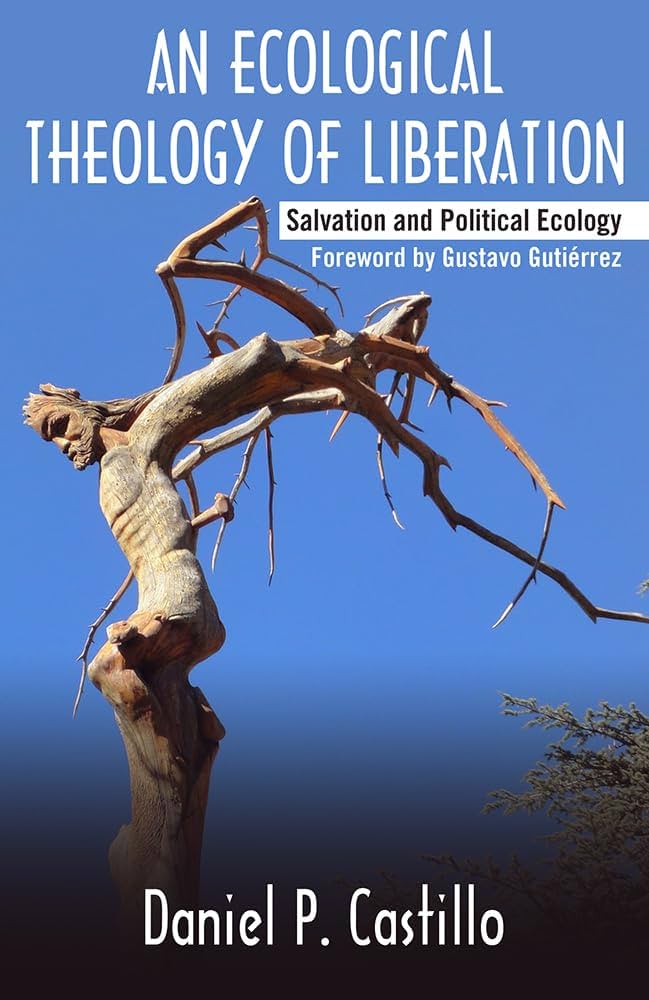
What is the relationship between salvation, liberation, and care for creation?
This is the central question surrounding David Castillo’s An Ecological Theology of Liberation: Salvation and Political Ecology. Castillo, a professor of theology at Loyola Marymount University, specializes in ecological theology, environmental ethics, and Latin American Liberation theology. Having recently transformed my own faith, I have become interested in the relationship between theological hermeneutics, conceptions of salvation/soteriological frameworks, environmental care, and the ways people of faith understand their relationship with (and responsibility towards) caring for the world around them.
I have come to learn that at the core of our social (in)action lies our conceptions of what it means to be saved by Christ. Being raised evangelical taught me that to be saved was ultimately to be redeemed from sin, be forgiven by God, and escape our deserved punishment of eternal Hellfire. Alongside this, I observed that our faith had very little involvement in addressing the social well-being of humanity.
This definition of salvation never satisfied me. Ultimately, this definition of salvation seemed to oversimplify what it meant to be “saved” and cheapened it to a message of escapism from this world. I have come to believe that to be saved is to be in partnership with the Creator, working with Him to redeem not only your own pain, but the suffering and injustice humanity faces.
This disconnect between what I interpreted as the gospel and the way people within my faith behaved created a deep sense of dissonance. Reading David Castillo’s book gave me the language to verbalize many of the same problems I encountered with previous theological conceptions of salvation. Although obvious to anyone but me, it has become clear that the correct theological interpretations of God would bring flourishing to the people and the Earth he has created. The theology we embrace has profound implications: it can either orient us away from the suffering of this world, or it can call us into the work of restoration, partnership with Christ to bring Heaven down to Earth.
What Does Evolution Teach Us About Suffering?
Eco-cosmology overemphasizes evolutionary progress, overlooking natural suffering, extinction, and the preferential option for the poor. The ecological cosmology of evolution tends to move away from the preferential option for the poor and the earth; e.g., in recounting “the universe story,” it is inclined to complexify the unfolding of the cosmos (life into more intricate forms of life) with higher forms of being replacing lower forms through evolution. Mass extinctions and the loss of life are often treated as necessary stages in the emergence of more complex life forms. This perspective celebrates the “strongest” surviving. This perspective effectively tramples over those deemed unfit enough to survive. Nature cannot always serve as the model for our ethics but as inspiration.
Castillo’s ethics calls for a “biocentric” approach to creation care. This opens the possibility of a divine and human responsibility to steward the Earth amid its imperfections. However, modern ethics actively critiques anthropocentric worldviews, and Castillo proposes a nuanced but similar perspective. I am curious about how a cosmology story of evolution, in which organisms survive or perish, evolve, and compete for life, complements a call for humanity’s stewardship of the Earth for a finite period. If we affirm a cosmology story of evolution while also acknowledging humans within the Anthropocene as stewards of the Earth, does this suggest humans are the highest and last form of creation? This also makes me reflect on the concept of the “great chain of being.” The great chain of being is a medieval/Renaissance idea that all living things in the universe are arranged in a fixed hierarchy. For example, minerals and inanimate matter may occupy the lowest level of this hierarchy, followed by plants, animals, and humans, with God positioned as the highest and source of being. In many academic circles, I hear critiques of this structure, as it promotes anthropocentrism, implying that nonhuman life has less value. However, it seems that a similar structure of power has presented itself within nature (food chains) and the concept of evolution. I often subconsciously view evolution through a concept that a stronger life form will emerge and the weaker will perish. However, at the same time, one could also view these relationships as a food web, in which there are differing relationships to different organisms. However, I still believe there can be a sovereign governing power (humans) that can override this structure and make judgment calls about the survival and well-being of the other levels. Personally, questions about the concept of sin and the origin of the universe have gotten me thinking about how these two concepts interact with each other. If evolution relies on suffering and death to advance life, does that mean sin was present at the time of the beginning of the universe? Did evolution happen before the introduction of sin or after, and what does this mean for God’s original design?
Is Anthropocentrism Always the Enemy?
Castillo uses the example of Lynn White’s essay “The Historical Roots of Our Ecological Crisis” in describing how the Christian worldview fosters a relationship that justifies the exploitation of nature through decentralization. At the core of White’s essay, Castillo proposes that he is, in fact, critiquing anthropocentrism, and this rhetoric nowadays has emerged widely in modern-day eco-theology and ethics. This phenomenon has presented itself in most of my classes here at Stanford, where I often hear critiques about anthropocentrism. In reflection, I have realized it has fostered very black-and-white thinking between human-environmental relationships. Castillo rejects both the definition of anthropocentrism that says humanity is the only entity with innate value and the idea that humans must dominate creation. What really stood out to me was the idea he proposes that decentering humans without any given system will actually ineffectively become conducive to caring for the earth and the poor. This anti-anthropocentrism, in Castillo’s mind, also effectively minimizes the responsibility humans have towards nonhumans, as one might view humans knowing what’s best for nature as “arrogance.” This is in part due to minimizing humans’ moral capacity for good! This text highlights how anthropocentrism inherently assumes the worst in us humans. Doing so also dismisses humans’ moral responsibility towards caring for the earth and the poor as part of our disordered nature. The way I have been able to internalize this critique is through using our relationship with God as a model; if he is loving, all-knowing, and rules over us with care, our value is apparent and affirmed because we are made in his image. Applying this same logic to humans in relation to nature, we can rule over nature while adhering to values that affirm the goodness God has made in us. As theologian James Gustafson states, although humans are not the measure of all things, we are the measure of all things. Highlighting our capacity for good through a qualified anthropocentrism allows us to bear moral responsibility for the earth and for the poor.
Reading Two Books: Scripture and Nature
Castillo proposes that the book of scripture and the book of nature can be utilized in conjunction to inform environmental stewardship. The moral responsibility to the poor and the earth should be informed by the proper sources of Christian “revelation.” Castillo provides two separate books of revelation that work in conjunction with one another to inform his environmental ethics. The first source is what he categorizes as “the book of scripture,” referring to the bible, doctrine, and tradition of the Christian faith, and the second is the book of nature, or creation. Castillo proposes that creation, in its complexity, can point to characteristics of its Creator. For example, the characteristics of interdependence, cooperation, and symbiosis found within ecological communities can inform a divine calling from the creator about both his character and a call for us to view others in a regard that views others with value. The second source, scripture, can also point to the creator through disclosing the characteristics of its author. These two books create what can be described as “the word of God,” revealing who God is and what he desires. In mainstream Christian tradition, I have observed that “the book of scripture” has been prioritized over the book of nature. This comes back to a theology of separation that mainstream Christians practice. God can only be viewed through one light, one angle, and has to be held up to a book that itself could have been impacted by the concept of “sin.” Even the book of nature has to be interpreted through a lens of scripture, rather than solely looking at the innate value nature has to tell us about the characteristics of God. Alternatively, the book of nature could be viewed as the end-all, be-all for our environmental and social ethics due to the perceived lack of human intervention, thus removing any selfish desires. However, nature also holds the realities of scarcity, predation, suffering, and competition. Nature also, even without human intervention, does not seek equilibrium. It is in a constant flux, changing as relationships within the biosphere morph and evolve. Castillo advocates for the use of both Scripture and nature to inform our understanding of the Creator, and therefore our ethics for creation care and for the poor. Scripture, despite its own flaws, still holds a unifying message of the Creator working with humanity to redeem the world from suffering and sin. Castillo’s ethic effectively draws upon both the goods that Scripture and nature have in informing our call for caring for the earth and the poor.
Salvation is More Than Escape!
We must revisit the definition of salvation if we are to care for the earth and the poor. Raised an evangelical Christian my whole life, I was extremely curious how Castillo’s soteriological frameworks lead us to a theology of liberation that creates care for both the poor and the earth. Evangelical theology, in my opinion, centers around a theme of separation. Sin and salvation are viewed through an otherworldly (and even anthropocentric!) lens, which often dismisses responsibility for caring for the Earth and the poor due to an individualistic focus on redeeming oneself from one’s own sin, a focus on personal accountability, and escape from the condition of this world. Sin is viewed as a deterrent to salvation, an infinite break from God through a given position in the afterlife, rather than looking at its definition as a whole. The world is seen as a holding space for the next, and sin tends to be a list of rules and regulations allowing us to continue into the afterlife. Alternatively, Castillo defines sin as not only a disconnection from God but also turning inward on oneself, resulting in a withdrawal from others. Ecologically and socially, to Castillo, salvation is viewed through a historical process of liberation, in which God comes in partnership with us to heal relationships between humans, the earth, and him, effectively including care for the poor and damaged creation. Reading Castillo’s work left me with a lot of questions pertaining to eschatological beliefs; however, it was his intention. Castillo critiques what he would call a “spiritual” approach to salvation, which I would categorize today as modern evangelical conceptions. This conception of salvation orients one away from the world and its pains to the hopes of being redeemed from them in the afterlife. However, being raised evangelical, I saw this manifest in the way we viewed our involvement socially. We no longer thought about helping others for the sheer sake of doing so but did it through a lens of proselytization. Effectively, we no longer challenge the status quo of injustices in this world and uphold it. If God placed us here on this Earth and he calls us to be in partnership with him, whose ultimate goal is to redeem us of sin, while he is also seen in “the least of these,” why would we not challenge the systems and structures that contribute to perpetuating them? After all, if we are effectively creating a hell on earth through our inability to challenge the structural sins of this world, what is the appeal of a faith that threatens one with a similar condition in the afterlife?


Leave a Reply